

Start Your UK Company Today.
Fast & Hassle-Free.
Experts handle the setup, so you can focus on growing your business.
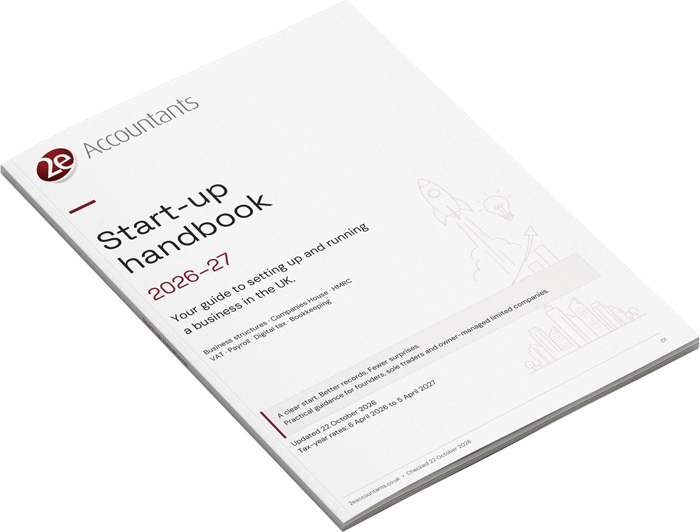
Download our free eBook
Ready to register your company name? Get our free guide packed with practical steps, tips, and everything you need to know to start strong.

Expert-led formation
The easiest way to register your limited company
Skip the hassle – we take care of the entire company setup from start to finish. No long forms, no confusing questions, just a smooth, stress-free process.
1. Complete our quick form.
2. Guide you through with options based on your situation.
Start-up specialists
Why use 2E Accountants to register your company?
Your accountant can help you understand what the requirements are to run a company and whether a company structure is even suitable for you or you will be better off run your business as a sole-trader.
Also, company matters can be complex and most people will hire an accountant to assist. Therefore, it is better to engage an accountant earlier so nothing slips through the cracks.
Registered Office address
Add-on for £20+vat per month
At 2E Accountants, we specialise in working with start-ups whether tech, e-commerce or any other service-based business. We offer our clients the best we can with the years of experience, talented professionals and the leading-edge technology.
Whether you need some basic bookkeeping help, or a full accounting support service, we have the flexibility and expertise to meet your needs. Check out list of our services here:
Complete your company registration
Know what it means to open and run a Company
How do I set up the company's ownership structure and share capital?
Choose a private limited company by shares. Decide on shareholders (owners) and their share percentages. Determine share capital (e.g., 100 shares at £1 each = £100 capital), setting a nominal value per share. Prepare Memorandum and Articles of Association (internal rules). Identify Persons with Significant Control (PSCs). Finally, register with Companies House with all these details.
What are the basic duties of company directors?
Directors must:
- Act within powers (company's rules).
- Promote company success (for shareholders' benefit, considering stakeholders).
- Exercise independent judgment.
- Exercise reasonable care, skill, and diligence.
- Avoid conflicts of interest.
- Not accept benefits from third parties related to their directorship.
- Declare interests in company transactions.
Also, ensure accurate records and timely filings with Companies House and HMRC.
What is a shareholders' agreement?
A shareholders' agreement is a private, legally binding contract between shareholders (and often the company). It governs their relationship, company management, and share ownership/transfer, providing more detailed rules than the public Articles of Association. It helps prevent disputes by clarifying decision-making, share transfers (e.g., pre-emption rights), funding, and exit strategies, offering specific protections (especially for minority shareholders).
What is the difference between Companies House and HMRC?
Companies House is the UK's company registrar. It incorporates companies and maintains public records of their legal details (directors, shareholders, accounts, etc.) under the Companies Act 2006.
HMRC (His Majesty's Revenue and Customs) is the UK's tax authority. It collects taxes (Corporation Tax, Income Tax, VAT, NICs) and enforces tax laws. Information shared with HMRC is generally confidential.
In short: Companies House for legal registration and public records, HMRC for taxation.
What information does Companies House require on an annual basis?
Companies House requires two main annual submissions:
- Confirmation Statement: An annual check to confirm company details (directors, shareholders, registered office, SIC codes) are up-to-date. Due 14 days after the review period.
- Annual Accounts (Statutory Accounts): Financial statements (Profit & Loss, Balance Sheet) detailing the company's performance and position. Due 9 months after your financial year-end (or 21 months for first accounts).
Late filing of accounts incurs penalties; repeated failure to file confirmation statements can lead to company dissolution.
How do I submit the company's annual accounts?
- Prepare Statutory Accounts: Based on your company's size (e.g., micro-entity, small), often with an accountant's help.
- File with Companies House: Submit approved accounts, preferably online (WebFiling/software), by the deadline (9 months after year-end, 21 for first). Penalties apply for late submission.
- File with HMRC (Company Tax Return - CT600): You don't send the full accounts directly. Instead, you use the financial figures to complete and submit your CT600 online to calculate Corporation Tax. This has a separate deadline (12 months after year-end) from the tax payment deadline (9 months and 1 day after year-end).
How does income tax work when making payments to directors and shareholders?
Payments to directors/shareholders are mainly salaries or dividends:
- Director's Salary (as employee):
- Subject to Income Tax (PAYE system) and National Insurance Contributions (NICs) for both employee and employer.
- Company can claim salary as a tax-deductible expense.
- Dividends (as shareholder):
- Paid from company's post-tax profits.
- Subject to Dividend Tax (different rates, with an annual tax-free allowance).
- No NICs on dividends.
- Not a tax-deductible expense for the company.
Many small company owners take a low salary (to save on NICs) and extract further profits via dividends for tax efficiency, requiring them to file a Self Assessment tax return.